
 Normal detection
 Longterm monitoring
 Nacelle monitoring
 Normal detection


Acoustic sampling
Record bat calls in real time
Bats are well protected animal and thus nature conserving laws give them an especially high status. This is due to heavy losses in populations within the last 50 to 80 years and some species got extinct already while others are on the brink of extinction. Bat surveys often are complicated, since bats lead a cryptic life. With the invention of the batcorder in 2004 we laid the foundation for modern acoustic bat surveys. Automated acoustic detection of bats as part of a mix of methods helps to give answers to many ecological questions on bats. It produces reliable and in the case of the batcorder comparable data. Focusing on high data quality - a necessity for species identification - and calibrated sensitivity of the detector, batcorder data can be compared over locations and years. Some users thus have collected 20 years of data at the same high quality level.
The most basic usage of passive acoustic detectors is to set it up at a single location repeatedly for one or a few nights throughout the year. Usually the detector samples for 2 to 4 nights and repeated for example each month. This already gives basic knowledge on bat phenology and species assemblage.
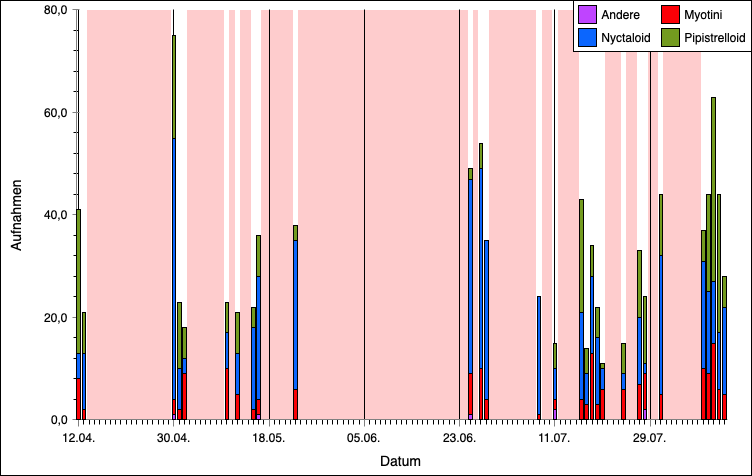
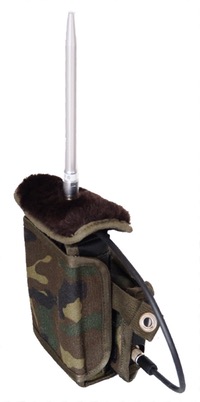
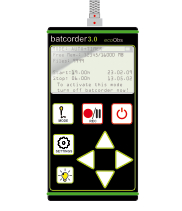
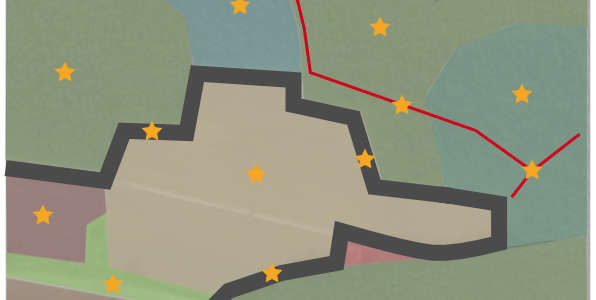
The batcorder 3.1 is suited well for such data acquisition tasks. Using the built battery it runs for two to four nights (in timer mode) and when using the external battery pack runtime exceeds 10 to 12 days easily. The usage itself is most simple. In typical surveys a couple of locations are sampled that way. Using the batcorder or multiple batcorders you can compare the data directly since the batcorder are calibrated to have the identical sensitivity.
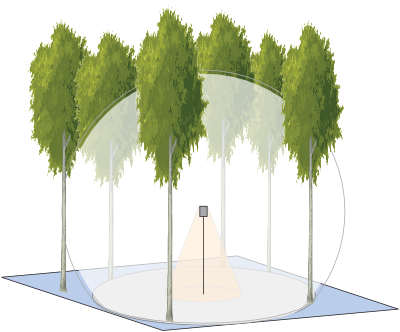
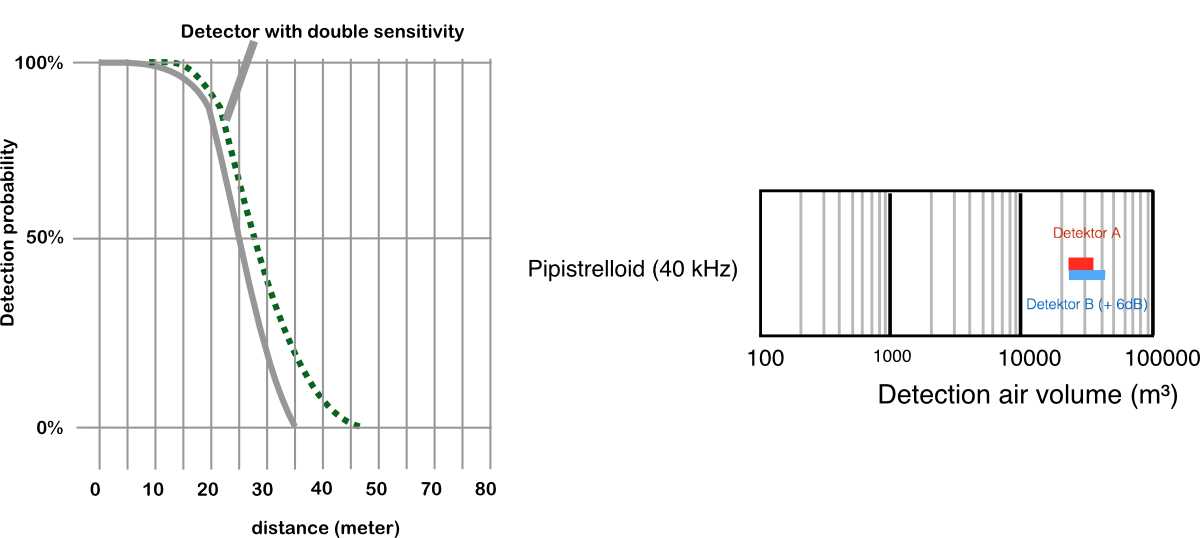
Quite often the detection range is asked by officials or other interested people. In theory quite an important question. Yet when looking at the principiles of sound propagation and detection - mostly physics stuff - one will quickly understand that range will be limited despite the actually used detector. One thing that stops sound propagation is the surrounding vegetation structures and another aspect is damping of traveling sound. We won't go into too many details - we do recommend the Handbook written by Volker Runkel - nevertheless let us introduce you into the magic of detection range.
The most influence on the detection range is caused by sound physics. Propagation of sound is decreased with frequency, so higher frequencies are more damped than lower frequencies. This damping easily reaches more than 1 dB per meter. Furthermore sound waves loose half their soundpressure level each time the distance doubles, thus get reduced by 6 dB. -20 dB resemble a tenth of the original sound pressure level. Thus even loud bat calls often can not be detected for more than 30 or 50 meters. Another factor is how loud the bat calls. Bats can vary their sound pressure level by a factor of ten easily. This fact also renders giving a certain fixed detection range impossible. Thus to describe detection range one should consider a probability distribution depending on distance. The detection starts with a very high probability at short distances and reduces over distance until a very low to zero probability is reached.
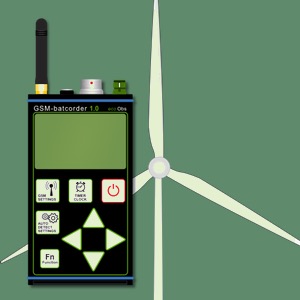
For the normal activity sampling for short periods repeated over time described in this document we do recommend the batcorder 3.1. If your requirements change you can continue to use the batcorder with the box-extension as well as with the wt-extension.